Album review: Nelle boche di gentaglia
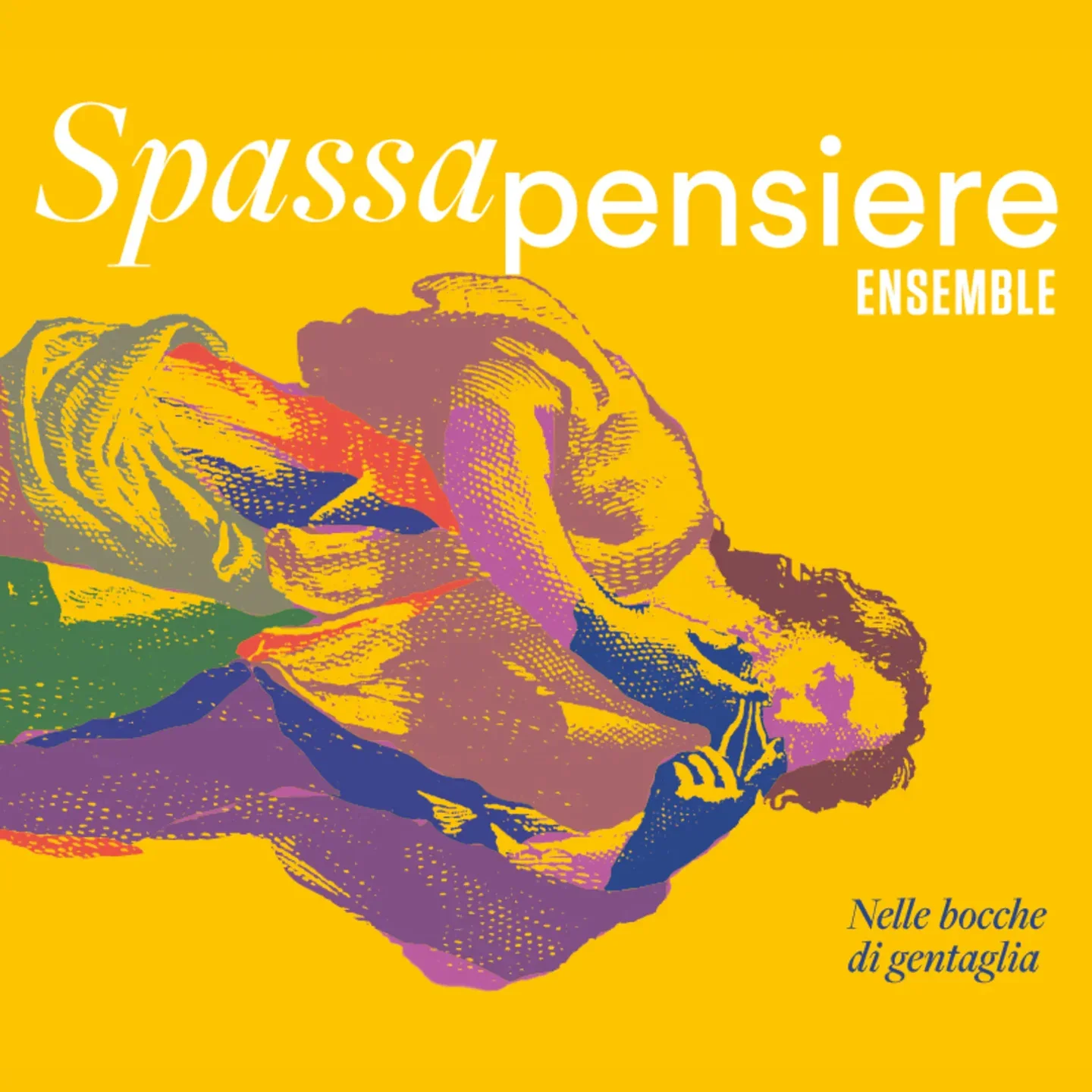
Spassapensiere Ensemble does a great job of combining rock-solid research with musical playfulness.
By Ånon Egeland
Translated by Lucy Moffatt
Nelle boche di gentaglia
Spassapensiere Ensemble
SimulArte
2025
Many people in Norwegian Jew’s harp circles have probably picked up on the fact that there’s plenty happening on the Jew’s harp front in northern Italy. Some may even have bought instruments from the productive and highly talented smith Luca Boggio, who lives in that part of the country. His exquisite copies of older regional Jew’s harps have been a decisive factor that made it possible for the Jew’s harp revival in the region to happen in the first place.
We have experienced this here in Norway too: Without good instrument makers, good Jew’s harp players would certainly have been much fewer and farther between. While several regions in south Italy, including Sicily and Sardinia, have living traditions for both Jew’s harp playing and forging, there is no documented tradition for Jew’s harp playing in northern Italy. The tradition died out somewhere in the period between the two world wars. The art of forging was also lost, but fortunately, there are well-preserved older instruments. These are just the tip of the iceberg when it comes to Jew’s harp production. The instrument is named in northern Italian sources from the second half of the 15th century and archaeological finds tell us that the instrument was known and used at least a hundred years before that. Jew’s harp production was particularly strong in the valley of Valsesia, in eastern Piemonte, from the 15th century to the late 19th century, not unlike what we know from Molln, Austria. And it is these Jew’s harps from Valsesia — some of them decorated with characteristic brass leaves in the frame — served as the model for Luca Boggio’s copies.
Of course, instrument makers are not the only important people when it comes to efforts to revive a broken tradition, where both instrument design and the music played on them need a local anchoring. Researchers also play an important role. In Norway, we are well aware of how important the research work of Reidar Sevåg in particular was for our own Jew’s harp renaissance.
In the case of northern Italy, Alessandro Zolt has played a similar role, both as an academic and a dedicated performer. Along with Alberto Lavatto, he wrote the ‘bible’ for Jew’s harp players in the area, La ribeba in Valsesia nella storia europea dello scacciapensiere (The Jew’s harp in Valsesia in the context of the European history of the Jew’s harp). The thick book contains everything you need to know about this forging tradition.
It’s possible to get a good idea of the instrument-making process by examining preserved instruments, but the music that was once played on these instruments has fallen silent. Very little is known about the repertoire, not to mention the subtleties of the playing style. It is precisely the pieces of this jigsaw puzzle that the Spassapensiere Ensemble (Luca Boggio, Lorenzo D’Erasmo, Lionello Morandi, Valerio Papa, Federico Rossignoli and Alessandro Zolt) are trying to put together, while simultaneously attempting to elevate the status of the Jew’s harp in general. Spassapensieri is by the way a variant of the standard Italian word for the Jew’s harp, scacciapensieri.
The musical element of the northern Italian Jew’s harp revival largely involves seeking out a suitable repertoire, then. Only a handful of melodies, have – according to tradition – supposedly been played on the Jew’s harp. Traditional dance tunes and songs from the region, as well as the occasional melody from Renaissance sources, are the most important resources.
This is reflected in the band’s album, Nelle bocche di gentaglia. (The title, which means something like ‘In the mouth of the rabble,’ refers to the Jew’s harp and is drawn from a treatise about the music published in 1628.) Promoting the Jew’s harp as a serious and flexible instrument is high on the agenda. The band has chosen to demonstrate this through arrangements in which the instrument is incorporated into ensemble playing both with other Jew’s harps and other instruments that are generally associated with the traditional music of northern Italy. I wasn’t familiar with the campanine, which looks roughly like an Orff xylophone, only with tone bars made of glass rather than wood. That gives it a nice, crisp tone. The campanine was a practice instrument for carillion players. The keyboard is a miniature of the carillion keyboard in a church tower, where every key is linked to a church bell.
Various percussion instruments are a recurrent theme in the group’s arrangements. It goes without saying that they have used modern sound technology to offset the natural imbalance between Jew’s harps and loud tambourines and bones (or clappers). The result can be pretty hefty, especially when Jew’s harps in bass register join the choir, but I think it works very well. One personal favourite that illustrates this is the closing track, ‘Girometta’ – a tune that’s alive and well in the tradition and is documented, in arranged form, as far back as the first half of the 17th century, including a version by the composer Tarquinio Merula (1595-1665).
Alessandro Zolt’s playing sounds almost Norwegian on ‘Rigodon’, a descendant of the fashionable rigaudon dance from the 17th and 18th century. It is still part of the living tradition in the Occitan-speaking region of France that borders with the Occitan-speaking part of Piemonte in Italy.
Many Norwegians will probably nod in recognition when they hear track 3, ‘La Monferrina’, the most widespread of the tunes originally used for a fashionable dance of the same name from the early 19th century. Here in Norway, it’s the tune used for a children’s rhyme called ‘Hønseføtter og gulerøtter” (Chicken’s feet and carrots). If we go further back, it has military links: it can be found in a handwritten tune book from Idd in Østfold county dated 1822, where it is called ‘Hviil Marchs’.
The physical CD has no accompanying liner notes, but a QR code takes you to some excellent digital liner notes in Italian, English and French, which provides plentiful information about the Jew’s harp in this part of Italy. Even the descriptions of the different tracks come with detailed bibliographies and discographies, in case any listeners are keen to take a really deep dive into the material.
I recommend the full package, which does a great job of combining rock-solid research with musical playfulness.
If you want to know more about what the members of the Spassapensiere Ensemble are up to, here are some links to two-thirds of them.
Luca Boggio:
https://www.youtube.com/watch?v=Ijak8r6PrIU
https://www.youtube.com/watch?v=qJHCClicVU4Alessandro Zolt: https://unito.academia.edu/AlessandroZolt
Lorenzo D’Erasmo: https://lorenzoderasmo.it/
Federico Rossignoli: https://open.qobuz.com/album/i6xmhufmui2ab