Under the microscope: Uppstaden
Uppstaden is a brilliant example of mastery of the art of variation.
By Ånon Egeland
Translated by Lucy Moffatt
If there’s one album any serious Jew’s harp player needs to play until they wear it out, it’s CD 1 of Fille-Vern (TA29CD, ta:lik 2006). On a single disk you’ll find all the iconic older players without whom the resurgence in the Jew’s harp of the past thirty years or so would never have happened.
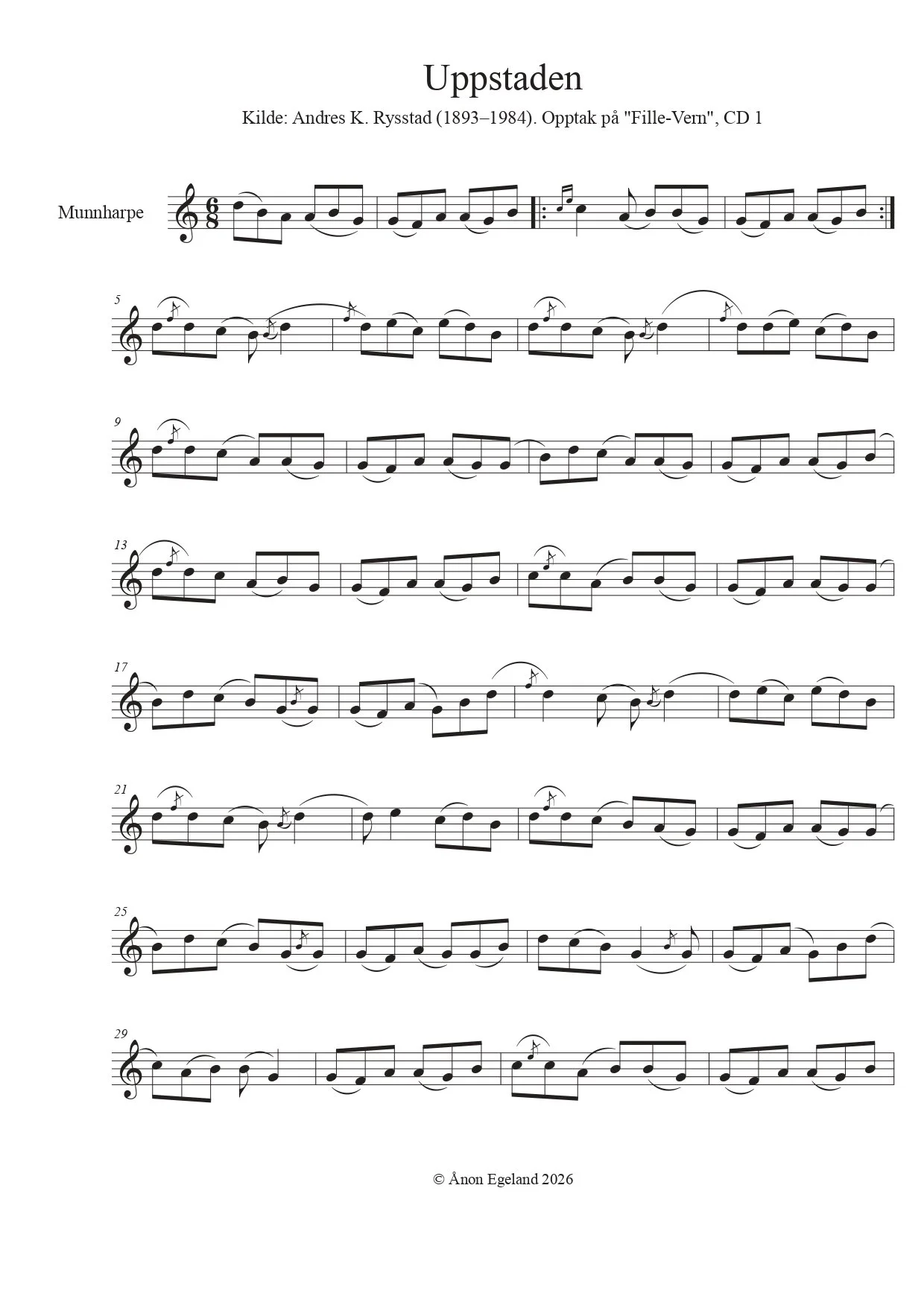
The tune we’re putting under the microscope this time, ‘Uppstaden’, is the penultimate track on the CD. It’s a brilliant example of mastery of the art of variation, immortalized by NRK on 27 May 1964. No matter what the sloppy indexing of the streaming platforms (including YouTube) may tell you, the performer is Andres K. Rysstad (1883-1984) and not fellow Setesdal man Aani Rysstad (1894-1965). (The moral of the story is: Always buy the physical album! In this case, you’ll also get 101 pages of liner notes into the bargain.)
None of the other oldest documented Jew’s harp players recorded this tune, which suggests that Andres based his Jew’s harp version on his own Hardanger fiddle version – a long tune with motifs from at least three older, shorter tunes. That means he must have used his musical knowledge to ‘distil’ the essence of a much longer tune. He will have had to reduce the compass from more than two octaves to just seven notes – more specifically from overtone 7 (transcribed F4) to overtone 13 (transcribed E5). That makes all the subtle variation an even more impressive feat.
On a first listen, Andres’ playing style may seem a bit subdued. He doesn’t use virtuoso techniques, focusing instead on variations: small changes in the melody, melodic rhythm and phrasing/striking patterns. Roughly speaking, his Jew’s harp version of ‘Uppstaden’ revolves around two short motifs, although this depends a bit on how you calculate it: the line between the ‘original motif’ (whatever that might be) and variation is fairly vague. On top of that, the motifs overlap in a way that makes it difficult to say where one ends and the other begins. In fact, it makes a lot of sense to view these motifs as circular, without a clear beginning or end.
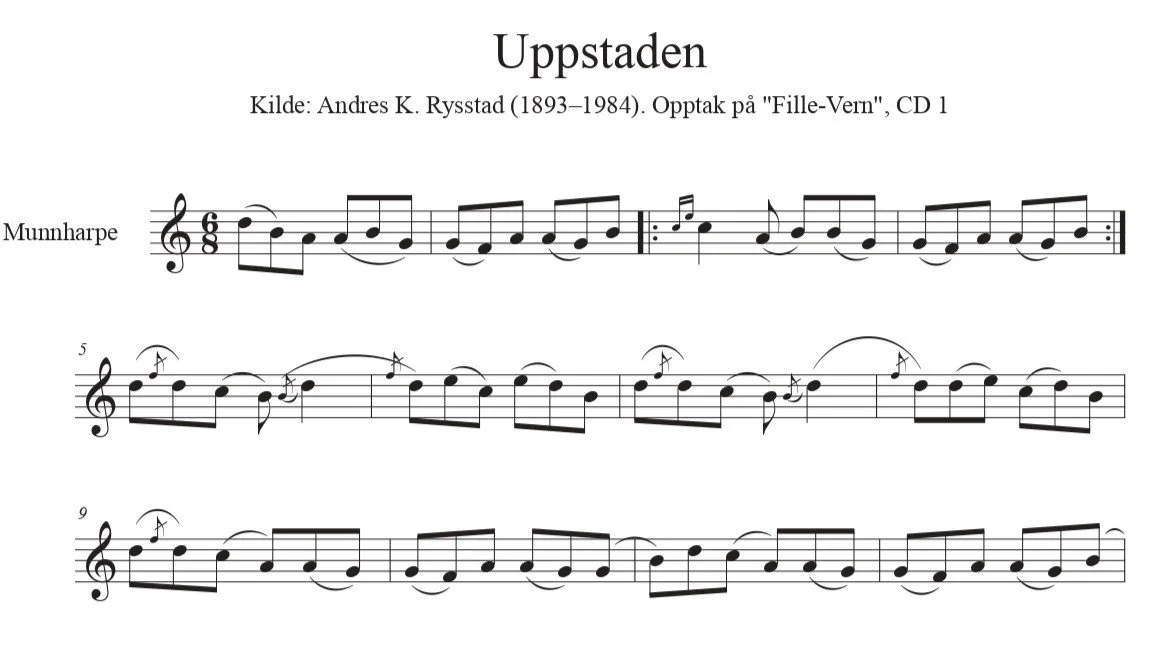
I hope as many readers as possible – even those of who are reluctant to use sheet music – will feel like using the transcription as an aid to taking a deep dive into the art of Andres Rysstad. A quick reminder that it’s perfectly fine to learn the melody by ear from the recording and just use the transcription for hints about where/when to strike (at the beginning of each tie) and which notes are open or closed (open notes are on the line, closed notes are in between). For those who are keen to go even deeper into the material, I recommend using digital tools that allow you to slow down the speed of the recording without affecting the pitch: Amazing Slowdowner and Transcribe! are good and relatively cheap options. And YouTube also has a similar tool that’s completely free. Click on settings (the cog icon on the right-hand side on the YouTube control bar) and go to Playback Speed. Also, see our earlier article about the Jew’s harp and sheet music.
The stomping isn’t specifically transcribed here, but Andres always ‘double-stomped’ for dance tunes. In other words, each beat is marked with an extra stomp immediately after the main stomp. In this case, that implies that the 1st, 2nd, 4th and 5th quavers are all marked with a right-foot stomp followed by a left-foot one. So: 1st quaver: right, 2nd quaver: left; 4th quaver: right, 5th quaver: left.
The tune is named after a Setesdal man called Bjørgulv Eivindsson Uppstad (1791-1866), because it was the one he would always insist on when he wanted to show off on the dancefloor. He’s probably best known as one of the old Kjempekar – huge men famed for their strength and prowess in a violent form of wrestling notable for having very few hard and fast rules.
The reason we know so much about him is largely down to the folklore collector Johannes Skar, who devotes no fewer than 20 pages of his book, Gamalt or Sætisdal, to the man. In Skar’s terse saga style, Bjørgulv Uppstad is an almost Viking-like figure – a fearless fellow who boldly challenges other big, strong men to test their strength. Few rules applied: knives probably weren’t seen as especially manly, though weapons such as poles and iron hooks seem to have been acceptable. One favourite tactic appears to have been ‘spooning the eyes’ – gouging out one’s opponent’s eyes with the thumbs.
The violent rural society Skar describes is probably far from unique to Setesdal and may well have been common across large swaths of Norway until well into the 19th century – in marked contrast to romantic notions of the good old days and local communities where people looked after each other. Of course, we should bear in mind that people tended to remember the most extreme events, which explains why they were committed to paper by people like Johannes Skar. While things may not have been as bad as they sound overall, we must surely be allowed to say that the world has improved since those days – in some respects at least. Fortunately, there’s no direct link between the music and the violent world of Bjørgulv Uppstad, although we must admit that he had good taste in music.