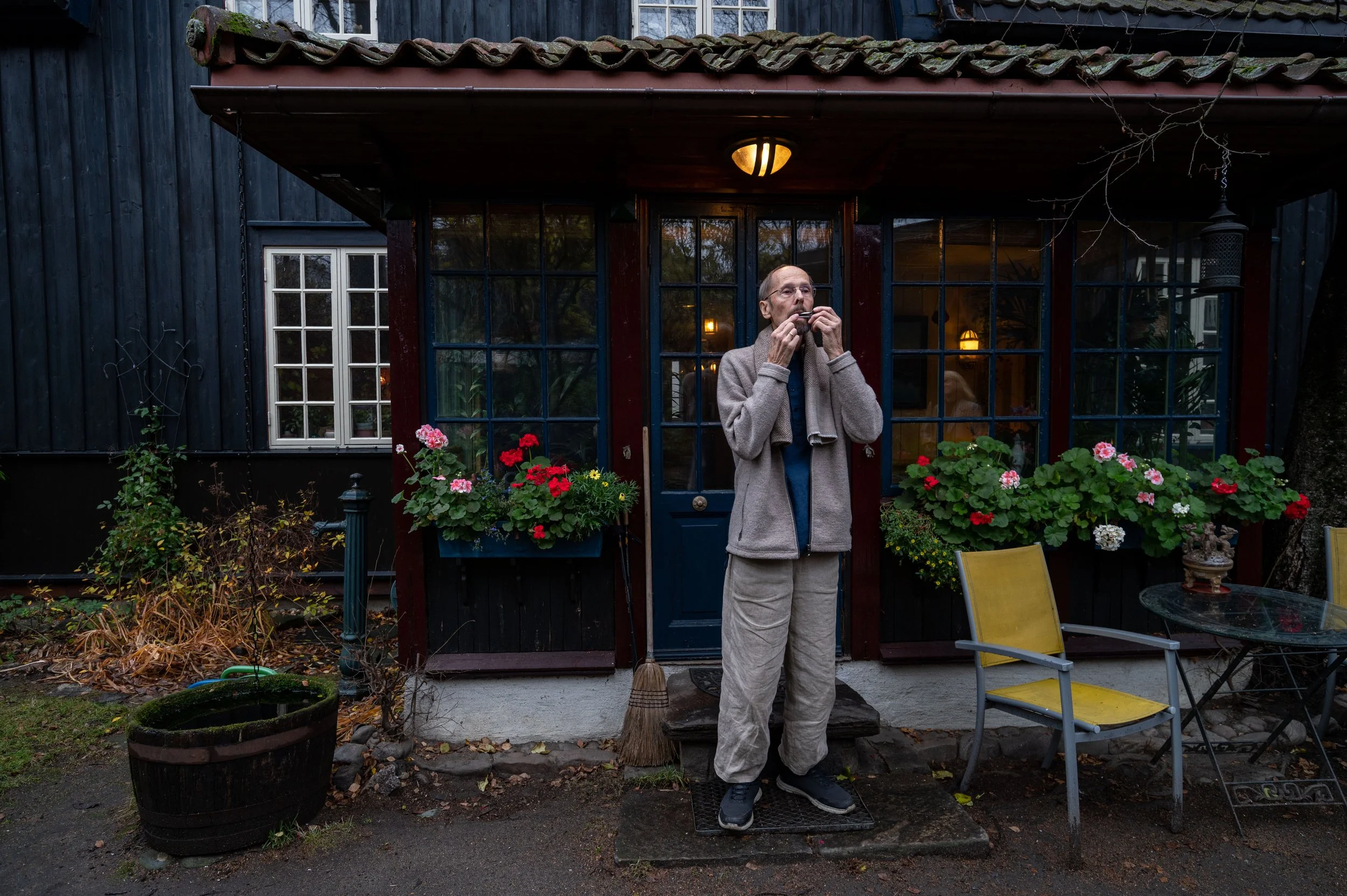
Svein Westad is 80!
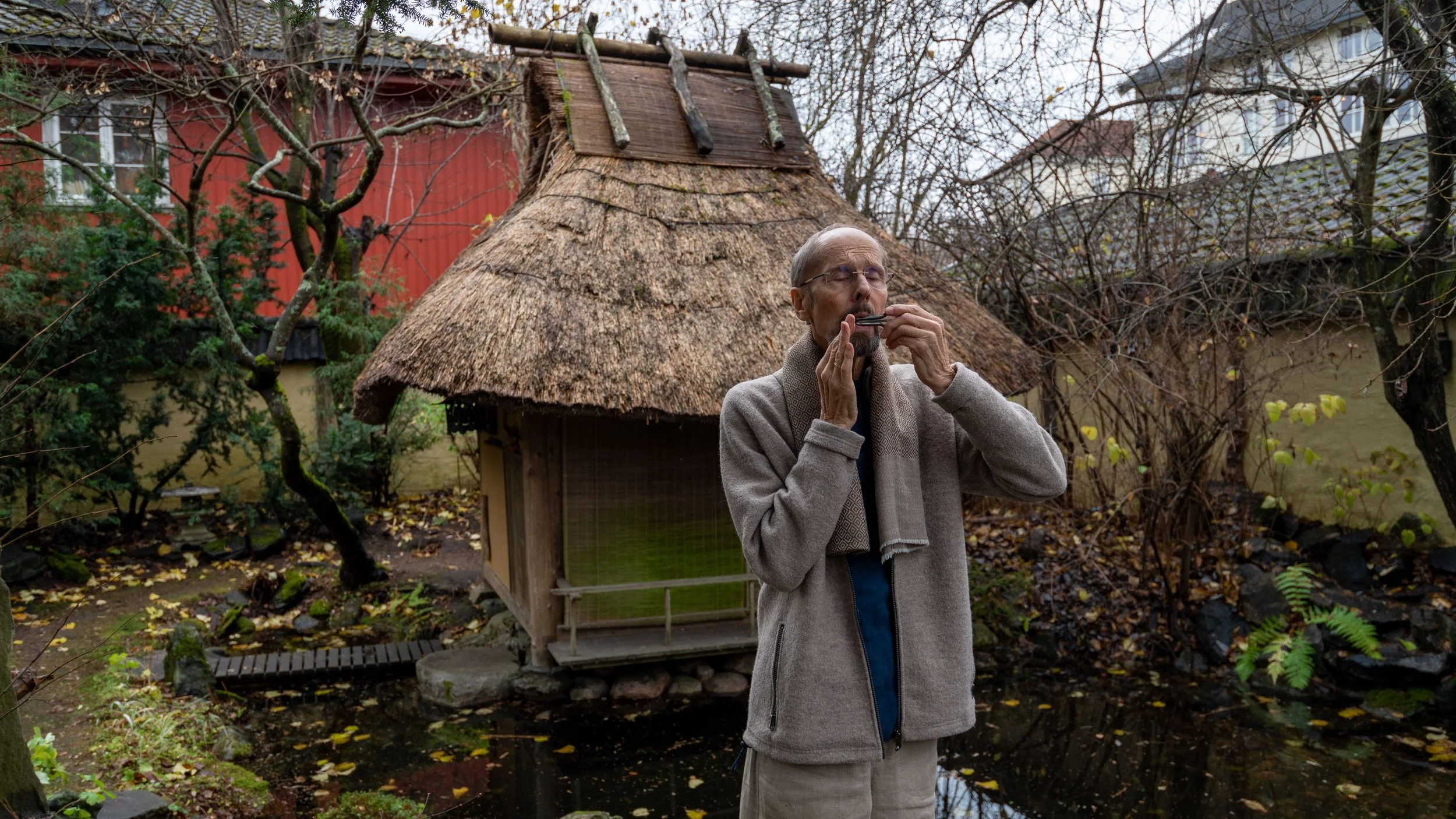
The first ever chair of the Norwegian Jew’s Harp Forum has made a name for himself as a Jew’s harp performer in many parts of the world world. Now he’s turned 80.
By Veronika Søum
Translated by Lucy Moffatt
Svein Westad had his 80th birthday on 17th March. We’d like to celebrate the Jew’s harp virtuoso’s special day with an interview he gave a few years ago for the norskmunnharpe.no project.
When did you first hear the Jew’s harp?
When I was 15 or 16, I was in a music shop in Tønsberg and bought an Austrian Jew’s harp without having heard very much Jew’s harp music before. I managed to get a tune out of it but I hadn’t a clue about traditional playing. All that started one evening at work when I was listening to Reidar Sevåg’s folk music programme on the radio in the early 1970s. That’s when I heard Mikkjel Kåvenes playing “Fille-Vern”. The radio was on low and those old recordings aren’t very good, so every now and then it would grow weaker, then stronger again, like the wind in the trees. And I stood there, almost glued to the floor, totally fascinated. I thought, “Oh, this is mysterious, I need to investigate this and get to the bottom of it,” and that’s what sparked my interest and my passion.
In 1982, I was playing overtone flute at a folk music festival where Torleiv Bjørgum was playing Jew’s harp. I went up to him afterwards and asked if it was possible to get hold of really good Jew’s harps. I made a sketch of his Jew’s harp, which was made by Knut Gjermundsson Hovet. I didn’t know who to ask because Gjermundsson Hovet was dead by then, but a few years later, I found out that Torleiv Bjørgum and Knut Tveit had started working together to produce Jew’s harps based on the old models. So I went to Setesdal and bought myself a Jew’s harp.
Just after that, in the early 1990s, there was a workshop. Back then, Bjørgulv Straume had just burst on the scene after releasing his famous track “Luftslaget”, which was a tremendous hit. He ran a weekend workshop. That’s where I grasped the technique, and then it was just a matter of going home and practising. Around that time, Ånon Egeland made some recordings of the old Jew’s harp masters available. As a young man, he’d visited Andres K. Rysstad, one of the few old Jew’s harp stars still alive at the time, and he’d made recordings of him and learned the technique there, so he was one of the leading lights back then. We had a lot to learn from after that. For around ten years I plugged and plugged away at various tunes.
In 1998, the Norwegian Jew’s Harp Forum was founded in Fagernes. Ånon Egeland didn’t want to be chair and asked if I wanted to do the job, so I became chair. From then on, workshops were organized and two or three of us who knew a bit so we became workshop leaders. After that it snowballed, with annual festivals.
What do you think makes a good tune?
A good tune is a matter of good rhythm, variation and a rich resonance. It shouldn’t be played the same every time, and colourless notes soon get boring: you have to modulate and vary and create your own personal style, that’s important. First you have to be able to listen and copy, so that you know what the starting point is and later you can create your own style. I was one of the players who used the full compass. Take ‘Fra i morgon til kveld’, a telespringar, and ‘Spursmannen’, where I played long notes, upwards and then downwards again. That’s also something I’ve worked on. I’ve heard a lot of people who simplify it rather a lot.
You’ve released several albums. How did Munnharpas verden (2000) come about?
There was an international Jew’s harp festival in Molln, Austria, in 1998, the same year we started the Jew’s Harp Forum. Ånon Egeland and I went along and that’s when we became aware of what other countries do. There was one Austrian player who played in three keys, switching harps as he played. There was more art music, but also a strong tradition there. But then there were people from the east too, from Yakutia in Siberia, and a small group from Kyrgyzstan. They played almost the same as we do and we were very keen to investigate further.
Everyone who plays on Munnharpas verden performed at that festival, and that was when we started to think about the album. There was Leo Tadagawa from Japan, the Paris-based Vietnamese player Tran Quang Hai and John Wright. I asked if they wanted to play on a CD collecting Jew’s harp traditions from all over the world. The four of us could play two or three traditions each, so there was quite a lot. There was a studio in Molln and while we were there I got them to record a fair number of things. Then we collected it together into Munnharpas verden.
You spent a year in Nepal as a music teacher. How did that happen?
I worked as an exchange teacher at the Nepal Music Centre in Katmandu in 2009 to 2010, teaching the Nepali Jew’s harp tradition with Norwegian technique. I ended up in Nepal thanks to a folk music festival arranged in North Korea of all places. I met a group of dancers from Nepal there, and it was a very fruitful collaboration. A girl I got to know invited me to Nepal and set up a concert for me. The day before that she took me to a music school in Katmandu that was built with Norad funding and is partly co-administrated with Norway, with the University of Agder in those days. While there, I met the teachers who were talented musicians! They played tabla, flute and the sarangi violin. Meeting in the Mountain (2008) was a collaboration with them.
What’s the best thing about the Jew’s harp?
It’s a mysterious instrument. Vibrations in the harmonics fascinate and affect us. I know that in Siberia they use it in therapy. The patients lie on their back and then they play on a deep Jew’s harp. You get these vibrations in your back, that make your muscles relax. I used to have a collaboration with the former director of Lågdal Museum. In the summer they would sometimes arrange history days involving stories about superstitions in olden times. I started to play for these events. I was probably planning to play “Fossegrimen”, I think. On the lower side there was a fence, and goats and sheep were grazing there with kids and lambs. I’d barely played four or five notes before they came charging up and stood there with their forelegs on the fence bleating away like crazy. I just had to stop. Everyone there found it jaw-dropping. So the Jew’s harp works on animals too. It’s a magical instrument of nature.
What does the Jew’s harp mean to you?
It means an awful lot. It’s not just about playing melodies but expressing the mystery of nature and bringing out those resonances that have such a powerful effect on our nervous system. Everything in creation is vibration, as shown by sympathetic resonance, vibrations and the Jew’s harp. There are shamans in Siberia and the northern regions who use the Jew’s harp specifically to make contact with a higher plane. So it’s a far from ordinary instrument.
You can find the whole interview and the video of Svein on norskmunnharpe.no.